Workplace Strategy
Human-Centric in an AI World: A Workplace Strategy Dilemma or Opportunity?
The assumptions behind most workplace decisions were set for a workforce that no longer exists. Here is how to tell, before you commit.
·
5 min read
Relevant to
Corporate
April 29, 2025 · Work/Shift Insights Issue #4
By Frederic Libet Descorne
I’m not here to romanticise “human-centricity” or panic about robots stealing our jobs. If you’ve read my work, you’ll know I tend to approach workplace strategy from a slightly different angle:
I care more about what trends do to people than how shiny they sound.
I write to be clear, not clever.
I’d rather explore tension than pretend we’ve solved everything.
And if something felt like jargon? Don’t worry—I’ve already cut it.
This piece is no different.
We talk a lot about human-centric workplaces.
We design for experience, for wellbeing, for belonging.
And now, AI has entered the chat.
It’s tempting to frame this as a collision course: humanity versus automation, empathy versus efficiency, meaning versus machines. But what if that binary thinking is the wrong lens? What if the real challenge and opportunity is to make both work together?
Because the question isn’t should we prioritise people or technology. The real question is: how do we design workplaces where both thrive?
We’ve automated the task. Now what?
AI is already reshaping how work gets done, who does it, where, and when. For many businesses, AI handles the logic, repetition, and optimisation. It takes care of the “knowns.” So what’s left for us?
Everything human.
The work of emotion. Collaboration. Meaning-making. Innovation. The unpredictable. The messy. The bold. These are no longer soft skills, they are the last remaining competitive edge.
And the research backs it up.
According to Microsoft’s 2023 Work Trend Index, 62% of employees spend too much time searching for information, exactly the kind of task AI is poised to streamline. But here’s the twist: 85% of leaders say building human connection is now more important than ever, especially in hybrid work environments. That’s not just a tech problem, it’s a spatial and cultural one.
So if AI clears the noise, what will we fill the space with? The answer should be: better human experiences.
We’re not designing places just for execution anymore. We’re designing places for connection, expression, learning, and trust.
The tech is smart. The space has to be smarter.
A meeting room that supports AI-augmented hybrid calls isn’t just about putting in another screen. It’s about sound quality. Eye contact. Time equity. It’s about making sure remote participants aren’t invisible. That ideas flow evenly, not hierarchically. That presence doesn’t equal power.
Likewise, a focus zone in the age of ambient alerts and digital assistants isn’t just about silence. It’s about protecting attention. Helping people shift between asynchronous creation and collaborative interruption without mental whiplash.
Technology will be ever-present. But space still shapes behaviour. And if we don’t evolve the environment, the tools won’t land. The strategy won’t stick.
Are we designing spaces that protect focus, support AI-enhanced collaboration, and build trust, or are we just adding tech to old problems?
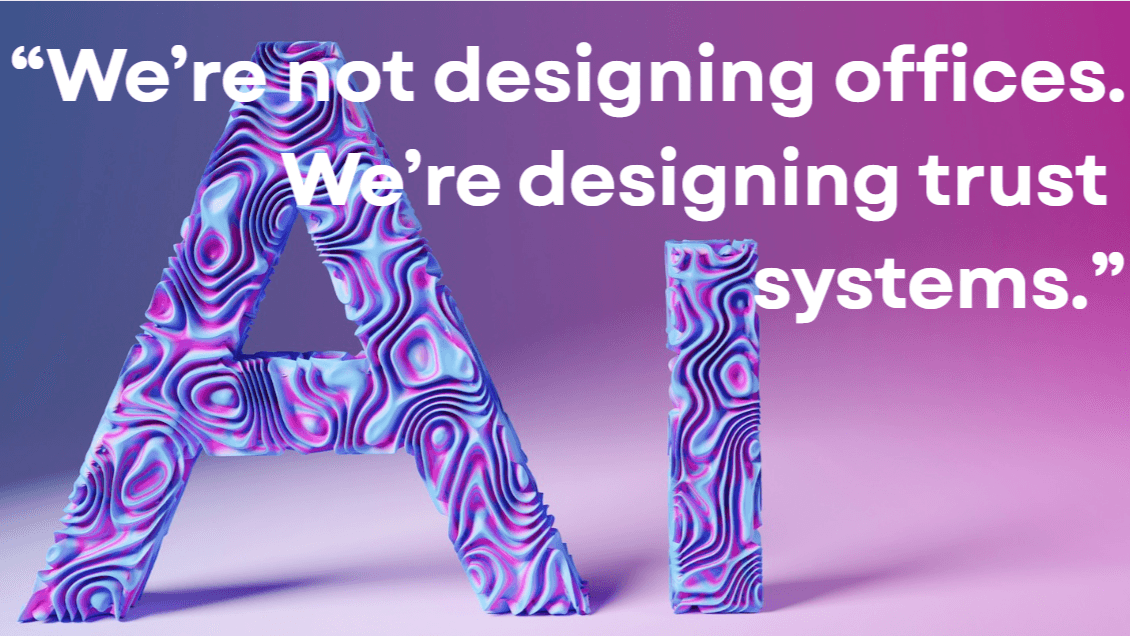
We’re not designing offices. We’re designing trust systems.
Let’s be honest: AI is going to test trust. In how decisions are made. In how information is collected. In what’s private, what’s predicted, and what’s “real.”
In this context, the workplace becomes more than functional, it becomes symbolic.
If your space feels overly transactional, impersonal, or surveilled? People will feel it. And they’ll resist. Not necessarily out loud but through disengagement, reduced belonging, or quiet exit.
But if your space signals transparency, safety, and care? That’s culture in physical form. It sets a tone, whether or not there’s an AI assistant whispering in the background.
Design is no longer neutral. It either builds trust or undermines it.
So where do we go from here?
If you’re a workplace strategist, designer, or leader trying to navigate this shift, don’t look for a playbook. Start with better questions:
Does our space support both AI-augmented and deeply human work?
Where might we be creating friction between technology and connection?
Are we measuring trust, attention, and creative energy, not just efficiency?
From there, think about how space can help people transition between modes of thinking, between screens and presence, between logic and meaning.
Design for recovery as much as performance. Be transparent about where and how AI shows up in the workplace. Create moments that feel unmistakably human because those are the ones that matter most.
The spaces that will thrive in an AI-saturated world won’t be the ones that digitise faster. They’ll be the ones that earn people’s energy and trust back.
Human-centric doesn’t mean anti-tech.
It means designing for what makes us human in a world where machines are doing more.
The best workplaces won’t try to out-tech the tools. They’ll create the context where trust, clarity, creativity, and adaptability can thrive.
In the words of IDEO’s CEO Sandy Speicher,
“We’re not going to outpace AI by becoming faster computers. We outpace AI by becoming better humans.”
That’s the opportunity.
So here’s the real question:
How do we make workplaces more human because of technology, not despite it?
That’s what I’m interested in. And it’s what our clients or employers need from us now.