Workplace Strategy
The Workplace Conversation Got Smarter. The Evidence Model Did Not.
The assumptions behind most workplace decisions were set for a workforce that no longer exists. Here is how to tell, before you commit.
·
5 min read
Relevant to
Corporate
Work/Shift Insights - Issue #19 | Fit-for-Purpose Workplace Strategy
By Frederic Libet Descorne
The workplace conversation has improved dramatically.
The language is sharper. The thinking is more nuanced. The industry is asking better questions than it was five years ago.
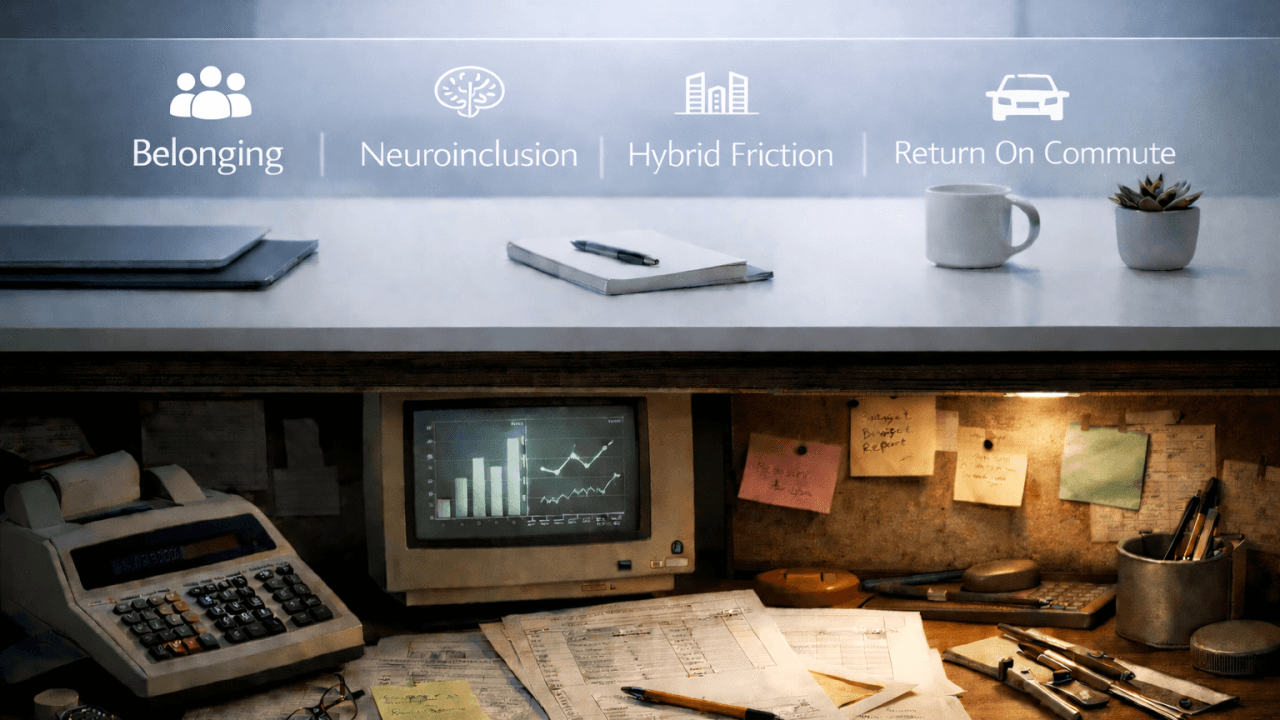
We now talk about personas, social health, neuroinclusion, return on commute, hybrid friction, and the office as a catalyst rather than just a container. That is real progress. It reflects a more mature understanding of work, and of what workplaces are supposed to do.
But there is a problem hiding underneath that progress.
The conversation got smarter. The evidence model often did not.
That is the gap.
I keep seeing briefs that sound like 2026 and are still built on 2016 inputs.
The words are current. The logic underneath them often is not.
A brief talks about focus, belonging, flexibility, culture, collaboration, and employee experience. It sounds thoughtful. It sounds human-centred. It sounds modern.
Then you trace what it is actually built on.
Headcount assumptions. Partial utilisation data. A workshop. A few stakeholder interviews. Confident leadership opinions. Maybe a satisfaction score or two.
That is not an upgraded evidence model. That is legacy input wearing better language.
And it matters, because better language can create false confidence.
An organisation starts to believe it has done the hard thinking because the brief sounds sophisticated. But sounding sophisticated is not the same as being validated. Naming the right themes is not the same as measuring what is true inside your organisation.
A persona framework can help you imagine the workforce. It cannot tell you which patterns dominate in your teams right now.
A stronger theory of work can improve the conversation. It cannot tell you where execution is slowing, where friction is accumulating, or what people are trading off every day to get through the work.
A well-written brief can sound completely aligned with strategy. It can still be wrong.
That is the field reality.
Most organisations are no longer making workplace decisions with primitive language. They are making them with sophisticated language and thin evidence.
The brief sounds better than ever. It is still often under-validated.
This is why so many workplace decisions feel right in presentation decks and disappointing in operation.
The concept is sound. The evidence underneath it is weak.
A leadership team says it wants more collaboration. Fair enough. But the evidence may show the real blocker is not collaboration at all. It is interruption load, poor acoustics, lack of follow-on focus space, or a hybrid model that keeps forcing fragmented work patterns.
A project team says it needs to attract people back to the office. Maybe. But the evidence may show attendance is not mainly about hospitality, events, or commute. It is about whether the workplace supports the actual work people are being asked to do when they get there.
This is what weak evidence does. It allows a brief to sound intelligent while still missing the operating reality.
And once that happens, everything downstream becomes harder.
The design team is solving the wrong problem more elegantly.
The project team is investing with more confidence than it should have.
Leadership believes it is backing a strategy when it may only be backing a narrative.
That is why I do not think the next upgrade the industry needs is more language.
We have enough language.
We do not need another layer of workplace poetry. We do not need more elegant ways to describe complexity. We do not need better labels for things we still have not measured properly.
We need the evidence model to catch up.
That means putting a real evidence layer between market insight and organisational decision-making.
Not a trend deck. Not a workshop that captures what people are comfortable saying in public. Not fragmented signals interpreted in isolation.
An actual evidence layer.
One that connects behaviour, culture, friction, hybrid patterns, environmental fit, digital experience, and space use into one view.
One that can tell you not just what people say they value, but what work actually requires.
One that can show where the brief is grounded, where it is thin, and where it is still carrying belief dressed up as fact.
Because that is the test now.
Not whether the workplace conversation sounds intelligent.
Whether the decisions can survive contact with evidence.
Can the brief hold up when Finance asks what assumptions it is built on? Can leadership explain what trade-offs are being made, for whom, and based on what proof?
If not, then the industry may have upgraded its vocabulary while the organisation is still making decisions on a pre-upgrade evidence model.
That is the real risk.
The workplace conversation has never been smarter.
The harder question is whether the decisions have caught up.
Who is upgrading the evidence inside the organisations still making workplace decisions on old inputs?