Workplace Strategy
Trust is the New Infrastructure
The assumptions behind most workplace decisions were set for a workforce that no longer exists. Here is how to tell, before you commit.
·
5 min read
Relevant to
Corporate
June 3, 2025 · Work/Shift Insights Issue #8
By Frederic Libet Descorne
What if we designed organisations the way we build bridges? Not just for strength, but for flow.
We engineer buildings to hold weight. We optimise floor plans for collaboration. We architect systems for speed. But when it comes to trust, most organisations cross their fingers and hope.
We assume it will emerge naturally, if we hire the right people, run a few workshops, and print the values in bold font. But trust doesn’t just happen. It cracks, leaks, and collapses unless we intentionally design for it.
Trust isn’t soft. It’s structural.
I learned that the hard way. I stepped into a leadership role where I inherited a team that didn’t know me, didn’t choose me, and didn’t want me.
I thought being approachable would be enough. It wasn’t. It needed one more thing: clarity. Boundaries. Proof under pressure.
In my workplace strategy work in Australia and other markets, I see the same pattern. Leaders invest heavily in space, systems and structure, yet often assume that trust will take care of itself.
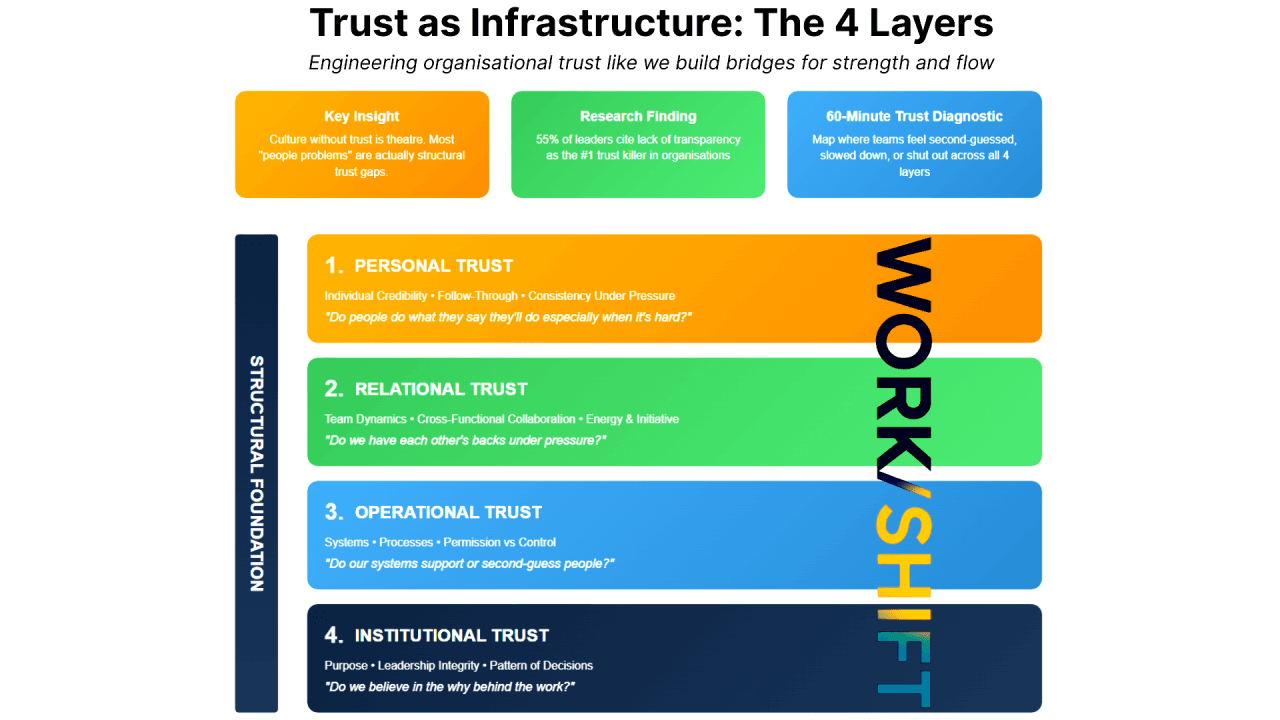
Designing for Trust: The 4 Layers
You don’t build trust by being nice. You build it by design. Like infrastructure, it has layers. And each layer supports the next.
Trust doesn’t live in slogans. It lives in systems. This framework helps leaders see where trust is reinforced or eroded, at every level.
Personal Trust - Human to human. Face to face or screen to screen.
My experience with trust spans cultures and contexts, not just between countries, but within them. In Thailand, I walked in thinking dialogue was universal. I was wrong. In many settings, listening carried more weight than talking. Silence wasn't awkward. It signalled respect. But that wasn't true everywhere. Bangkok startups often valued directness more than traditional businesses. Younger professionals moved fluidly between styles. In Australia, directness generally built credibility. But again, it depended. Colleagues with Asian heritage often blended approaches. In diplomacy and government circles, even Australians leaned toward measured, cautious tones. The insight wasn’t about cultural labels. It was about cultural intelligence. Seeing patterns without getting trapped by them. Reading individuals. Reading the room. The method shifted. But the outcome stayed the same.
People trusted me when I did what I said I would. Consistently, not loudly.
2. Relational Trust - Culture lives in the space between people.
I inherited a fractured setup. Creative and commercial teams working in polite silence. No overt conflict. Just hoarding, hesitancy, and low energy.
We didn’t need a restructure. We needed to reset how people showed up together. We introduced new meeting rhythms, transparent agendas, and made space for candour, not performance.
The shift didn’t come from a deck. It came from how people felt in the room. Week by week, posture changed. Energy shifted.
Relational trust isn’t about harmony. It’s about having each other’s backs under pressure.
3. Operational Trust - Your systems tell the truth about what you believe.
In one senior role, I had strategic mandate, except when it came to editing client language. Every approval I needed whispered, "We don’t really trust you."
In another client project, inclusion protocols had become so rigid that even empathetic leaders felt paralysed. They were afraid to move. We stripped it back. Co-created simpler processes anchored in intent and permission, not fear. Momentum returned. So did initiative.
Every extra step in the name of control is a silent tax on trust. And it compounds fast.
4. Institutional Trust - The foundation. The why behind the work.
I supported a team in China through a sudden restructure. The business case was sound. The vision hadn't changed. But morale had crashed. People didn’t trust how decisions were made or if they were hearing the whole story.
We rebuilt trust in small moments. Weekly leadership Q&As. Clear language. No spin. No sugar. Just honesty on repeat.
One leader shared a mistake openly. That one moment shifted the room.
When trust is broken at the institutional level, it isn’t restored with a message. It’s restored with a pattern.
Maybe It’s Not a Culture Problem
Let me offer a provocation:
Most culture issues are actually trust issues wearing makeup.
We blame engagement. Blame hybrid. Blame Gen Z. But if people don’t trust their leaders, their systems, or each other, no ping-pong table or purpose statement will fix it.
Culture without trust is theatre. Engagement without trust is noise. Strategy without trust is fiction.
In a pulse poll I ran while writing this piece, I asked 200 leaders to identify their biggest trust challenge. The pattern was clear:
55% said leadership lacks transparency
23% pointed to people not following through
11% flagged teams working in silos
11% cited controlling systems
The takeaway? Trust doesn’t break down in one dramatic moment. It erodes quietly, layer by layer. It starts at the top but gets reinforced through everyday behaviours, misaligned teams, and systems that second-guess instead of empower.
Build the Infrastructure
So how do you fix it?
If culture is the water we swim in, trust is the plumbing. Invisible when it works. Messy and expensive when it leaks.
The good news? You don’t need a restructure. You need a redesign.
Run a 60-Minute Trust Audit Sprint
Ask your team: Where do you feel second-guessed, slowed down, or shut out?
Map the answers to the four layers: Personal, Relational, Operational, Institutional
Choose one weak layer and co-design a small fix
Example: If relational trust is low, introduce "unfiltered feedback Fridays" or turn your team check-ins into problem-solving circles
Commit to a 30-day experiment
Most important of all: Measure energy, not just output.
If the vibe lifts, the results usually follow.
Trust Is Maintenance
I still ask myself:
Where am I unintentionally signalling doubt through silence, process, or the way I structure decisions?
Because trust isn’t achieved. It’s maintained. And in a world that moves faster than people can process…
Trust is the only thing that slows down the spiral.
Not as a safety net. As a foundation. The thing strong enough to carry everything else we build and keep it standing.
If you are leading workplace strategy in Australia or across a global portfolio and know that trust is part of the friction, Work/Shift can help you map where it is leaking and how to rebuild it. Learn more about our independent workplace strategy in Australia and globally.